Showing posts with label bass traps. Show all posts
Showing posts with label bass traps. Show all posts
Tuesday, October 8, 2013

Tuesday, October 1, 2013
New Beatport Chart from King Felix
King Felix has released another DJ chart full of great tunes. make sure to look for Dynamite Jacksin's newest release "Struggle" on there along with "Let Lucid". The full chart can be found on
http://www.beatport.com/charts/new-music-chart/217438

DJ Profile
NEW MUSIC CHART
by King Felix 2013-09-24
Tech House / Indie Dance / Nu Disco / Techno / Deep House / House / Pop / Rock
Some songs we have been listening to along with some new tracks released by Itchy Tasty Records.
playqueue$21.90Buy


TRACK NAME ARTISTS REMIXERS LABELS GENRE RELEASE DATE
playqueue
 Struggle (Original Mix) Dynamite Jacksin Itchy Tasty Records Tech House 2013-09-23 $2.49Buy
playqueue
Struggle (Symphonic Mix) Dynamite Jacksin Itchy Tasty Records Pop / Rock 2013-09-23 $2.49Buy
playqueue
 Let Lucid (Original Mix) Dynamite Jacksin Itchy Tasty Records Tech House 2013-09-17 $1.99Buy
playqueue
 What To Do (Infinity Ink Remix) Francesca Lombardo Infinity Ink Crosstown Rebels Deep House 2013-09-23 $2.49Buy
playqueue
 Sacrifice (Original Mix) Simian Mobile Disco, Bicep Defected Techno 2013-09-08 ALBUM ONLY
playqueue
 Cielo (Bicep Remix 2) Aster Bicep Hivern Disc House 2013-09-23 $1.99Buy
playqueue
 Manic (Maceo Plex Lost Version) Azari & III Maceo Plex Turbo Recordings Indie Dance / Nu Disco 2013-09-09 $1.99Buy
playqueue
 Slow Moves (Original Mix) Loco Dice Cocoon Recordings Tech House 2013-09-09 $1.99Buy
playqueue
 A Night Like This (Richie Hawtin's A Night Like That Remix) Steve Bug Richie Hawtin CR2 Live & Direct Unmixed Tech House 2013-09-02 $1.99Buy
playqueue
 Depress (Original Mix) Jon Gurd Det Sync Techno 2013-09-23 $2.49Buy
http://www.beatport.com/charts/new-music-chart/217438
DJ Profile
NEW MUSIC CHART
by King Felix 2013-09-24
Tech House / Indie Dance / Nu Disco / Techno / Deep House / House / Pop / Rock
Some songs we have been listening to along with some new tracks released by Itchy Tasty Records.
playqueue$21.90Buy
TRACK NAME ARTISTS REMIXERS LABELS GENRE RELEASE DATE
playqueue
Struggle (Original Mix) Dynamite Jacksin Itchy Tasty Records Tech House 2013-09-23 $2.49Buyplayqueue
Struggle (Symphonic Mix) Dynamite Jacksin Itchy Tasty Records Pop / Rock 2013-09-23 $2.49Buyplayqueue
Let Lucid (Original Mix) Dynamite Jacksin Itchy Tasty Records Tech House 2013-09-17 $1.99Buyplayqueue
What To Do (Infinity Ink Remix) Francesca Lombardo Infinity Ink Crosstown Rebels Deep House 2013-09-23 $2.49Buyplayqueue
Sacrifice (Original Mix) Simian Mobile Disco, Bicep Defected Techno 2013-09-08 ALBUM ONLYplayqueue
Cielo (Bicep Remix 2) Aster Bicep Hivern Disc House 2013-09-23 $1.99Buyplayqueue
Manic (Maceo Plex Lost Version) Azari & III Maceo Plex Turbo Recordings Indie Dance / Nu Disco 2013-09-09 $1.99Buyplayqueue
Slow Moves (Original Mix) Loco Dice Cocoon Recordings Tech House 2013-09-09 $1.99Buyplayqueue
A Night Like This (Richie Hawtin's A Night Like That Remix) Steve Bug Richie Hawtin CR2 Live & Direct Unmixed Tech House 2013-09-02 $1.99Buyplayqueue
Depress (Original Mix) Jon Gurd Det Sync Techno 2013-09-23 $2.49Buy
Sunday, September 22, 2013
What is an ADSR Envelope?
ADSR Envelopes are an important concept to understand when learning about music production. They are integral in how to go about crafting sounds.
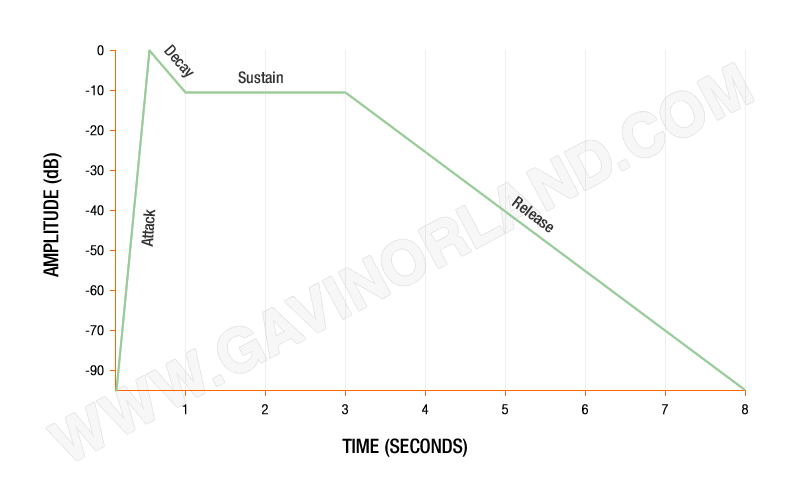
The envelope from http://www.gavinorland.com/tutorials/what-is-an-adsr-envelope/ below
ADSR ENVELOPE
Above, you can see a diagram of an ADSR envelope. I have actually drawn this with realistic proportions. If you imagine a key being pressed on a physical or virtual MIDI keyboard, with a pad patch selected, it might typically produce a sound matching this envelope, and the envelope represents the amplitude (or volume) of the sound generated over time. Let’s have a look at its phases:
Attack phase
The attack phase begins when the MIDI “note on” message is received – when the key is pressed or the note is encountered in a sequencer. You can see in the diagram that this pad begins inaudible then rises in a period of only half a second to the maximum digital volume of 0dB. So this pad starts quite quickly.
Decay phase
The decay phase defines how long the note will take to reach a settled volume after hitting the attack peak. That settled volume is usually lower than the attack peak, since notes in natural instruments tend to “stab” in then fade in intensity a little, but it could indeed be higher. In the example above the pressed note fades again over half a second to a slightly lower amplitude.
Sustain phase
The sustain phase is an important one to understand because the envelope does not determine its duration. Thus the length of the horizontal bar in the diagram (indicating 2 seconds) is actually quite arbitrary. The sustain level is the volume at which the decay will finish and the note will be held at this volume until the MIDI key is released and a “note off” message is received. So this could be after one second or perhaps six seconds.
Release phase
Once the note has been released, the envelope enters its release phase. The line of the envelope here defines how long the note’s volume will take to fade to zero. So in our pad here, it takes a full five seconds, so this is quite a long fade out (with reverb applied it would take even longer!).
Envelope lines do not need to be straight: many synthesisers will allow you to make them curved, making sharper attack sounds, for example. Some even allow additional phases. This, in any case, is the essential outline of the ADSR envelope.
Tuesday, September 10, 2013
Itchy Tasty Records on Floating floors for the recording studio!!1 Acoustic treatment below your feet.
Itchy Tasty Records on Floating floors for the recording studio!!1 Acoustic treatment below your feet.
Types of Acoustic Floating Floors
Floating floors systems are used for many purposes, predominantly sound isolation but also vibration and impact isolation.
In layman’s terms, acoustic flooring is required to reduce noise (or vibration) from a noisy room or environment to areas that need to be quiet. If they are incorporated with acoustically isolated walls and ceilings the combination will greatly reduce the noise levels or energy transmitted to the quiet areas. This is then known as 'box in box'construction.
There are several acoustic flooring systems available. LDS rubber FSN jack-up, FS spring jack-up, MFS spring mounts for wooden floors & EAFM form work method. These flooring systems are used to acoustically isolate a room from its surroundings. The nature of the noise/vibration will dictate the best solution.
• The concrete jack-up system, either LDS rubber or spring, for which Mason UK offers a full design and installation service.
• The concrete formwork system, where concrete is poured on a plywood layer placed on LDS rubber isolators.
• Lightweight wooden acoustic sports flooring, either on LDS rubber floor isolators or low profile floor springs.
Box in Box
Well-designed studios incorporate the 'box in box' concept, which is an acoustically isolated room, built within the existing structure. This room (or box) is totally separate from the original structure, only connecting through the various spring or rubber components of our products. These acoustic isolation products create an air gap, which controls air-born noise, working in the same way as double-glazing.
Jack-Up LDS Rubber Floating Floors
The Mason FSN Jack-Up system eliminates the need for the labour intensive installation of shutters & the lifting process ensures the airgap without the possibility of bridging. The elastomer used is now LDS (Low Dynamic Stiffness)rubber which is a recent advanced formulation that has the low dynamic

Jack-Up Spring Floating Floors
Mason Industries jack up, spring, acoustic, floating floors are used for low frequency isolation or where impact isolation is required, such as bowling alleys, aerobics & health clubs. Click below to find out more.

Wooden Floating Floors
Wooden floating floors using the Mason MFS spring mount are great for acoustic sports flooring. Their lightweight design means they are often suitable where concrete flooring is not. Click below to find out more.

Form Work Floating Floor
The formwork system is an alternative to jack-up floating floors. The method is one whereby a continuous layer of the isolation media (EAFM Form work mounts) is used as a pouring surface.

Tomorrow we will go into greater detail about how which type of floating floor application
is appropriate for each type of flooring that you would find. ie, concrete, wood, stone, brick, carpet, apartments, houses, decks you name it.
Types of Acoustic Floating Floors
Floating floors systems are used for many purposes, predominantly sound isolation but also vibration and impact isolation.
In layman’s terms, acoustic flooring is required to reduce noise (or vibration) from a noisy room or environment to areas that need to be quiet. If they are incorporated with acoustically isolated walls and ceilings the combination will greatly reduce the noise levels or energy transmitted to the quiet areas. This is then known as 'box in box'construction.
There are several acoustic flooring systems available. LDS rubber FSN jack-up, FS spring jack-up, MFS spring mounts for wooden floors & EAFM form work method. These flooring systems are used to acoustically isolate a room from its surroundings. The nature of the noise/vibration will dictate the best solution.
• The concrete jack-up system, either LDS rubber or spring, for which Mason UK offers a full design and installation service.
• The concrete formwork system, where concrete is poured on a plywood layer placed on LDS rubber isolators.
• Lightweight wooden acoustic sports flooring, either on LDS rubber floor isolators or low profile floor springs.
Box in Box
Well-designed studios incorporate the 'box in box' concept, which is an acoustically isolated room, built within the existing structure. This room (or box) is totally separate from the original structure, only connecting through the various spring or rubber components of our products. These acoustic isolation products create an air gap, which controls air-born noise, working in the same way as double-glazing.
Jack-Up LDS Rubber Floating Floors
The Mason FSN Jack-Up system eliminates the need for the labour intensive installation of shutters & the lifting process ensures the airgap without the possibility of bridging. The elastomer used is now LDS (Low Dynamic Stiffness)rubber which is a recent advanced formulation that has the low dynamic

Jack-Up Spring Floating Floors
Mason Industries jack up, spring, acoustic, floating floors are used for low frequency isolation or where impact isolation is required, such as bowling alleys, aerobics & health clubs. Click below to find out more.

Wooden Floating Floors
Wooden floating floors using the Mason MFS spring mount are great for acoustic sports flooring. Their lightweight design means they are often suitable where concrete flooring is not. Click below to find out more.

Form Work Floating Floor
The formwork system is an alternative to jack-up floating floors. The method is one whereby a continuous layer of the isolation media (EAFM Form work mounts) is used as a pouring surface.

Tomorrow we will go into greater detail about how which type of floating floor application
is appropriate for each type of flooring that you would find. ie, concrete, wood, stone, brick, carpet, apartments, houses, decks you name it.
Subscribe to:
Posts (Atom)