Showing posts with label Best electronic dance music artists. Show all posts

Tuesday, January 7, 2014

Circle Progressions

Circle Progressions
An excerpt from Chord Progressions For Songwriters.

Below is the circle of fifths (also referred to as cycle of fifths, chords, or keys) that shows the most logical, natural movement of one chord to another in Western music. Each of the twelve letters is arranged like numbers on a clock representing the root notes of a chord of some quality (major, minor, or dominant seventh). As you move counterclockwise around the circle, each chord root descends in an interval of a perfect fifth (three and a half whole steps). Moving clockwise, each chord root descends in an interval of a perfect fourth (two and a half whole steps). This series of chords demonstrates the strong tendency or pull of the “V” (dominant) to “I” (tonic) chord. This is the strongest chord movement, or cadence in Western music. Moving counterclockwise through the circle of fifths is often referred to as backcycling. Some of the best songs ever written have been created using cycles of descending fifths such as the “Am7-Dm7-G7-Cmaj7” progression that moves through the circle until ultimately arriving at the tonic.


The circle of fifths can be used to create chord progressions by starting with any chord on the circle and moving in either direction using as many or as few consecutive chord roots as you like to produce a new chord sequence. Circle progressions often begin with the “I” (tonic) chord before proceeding through the circle of fifths. The resulting chords can be major, minor or dominant seventh qualities (or any combination) that can be further embellished, altered, or substituted. For example, if you start with “E” and move counterclockwise to “C” you create the “E-A-D-G-C” chord sequence. Then, by designating a major, minor, or dominant seventh chord quality to each root note you can create the “E7-A7-D7-G7-C” and “Em-Am-Dm-G7-C” progressions. You can also start the sequence with the “C” (tonic) before proceeding through the circle of fifths creating the “C-E7-A7-D7-G7-C” progression. Although many of the progressions you will explore in this book including the basic (C-F), classic rock (C-Bb-F-C), folk (C-G), jazz (Dm7-G7-C), ragtime (C-A7-D7-G7), and standard (C-Am7-Dm7-G7) utilize chord sequences based on circle of fifths movement, generally only cycles of four or more chords from the circle of fifths in succession are referred to as circle (circular or circle of fifths) progressions. The possible progression combinations that can be created using the circle of fifths are almost endless and are found in classical music as well as in jazz and popular songs.


In this chapter you will explore some of the many ways the world’s most creative songwriters have used circle progressions to create hit songs. You will learn about the two types of circle progressions, those that descend in fifths and fourths. You will also take a quick look at a couple of ideas from my songwriter’s notebook. Lastly, your assignment will be to work through several exercises to get you started building your own circle progressions.


Descending Fifths


In this section you will look at six chord progressions that move counterclockwise around the circle in descending fifths. Play through each progression example and thoroughly understand how it was created before moving on to the next progression. Although these examples are presented in the key of C or Am, they should be transposed (see “Appendix”), played, and studied in other keys.


B-E-A-D-G-C Cycle


This cycle travels counterclockwise from “B” to “C.” The “B7-E7-A7-D7-G7-C” and “Bm-E7-Am-Dm-G7-C” progressions are two common types of this cycle. The first type is called a cycle of dominant seventh chords. An example of this type of cycle that uses secondary dominant sevenths is the verse progression to the Chordettes’ 1954 hit Mister Sandman shown below. A secondary dominant is a chord that serves as the “V” of another. For example, in the “B7-E7-A7-D7-G7-C” progression the “B7” is the “V” of the “E7” chord and the “E7” is the “V” of the “A7” chord. Similarly, the “A7” is the “V” of the “D7” chord and the “D7” is the “V” of the “G7” chord.

C / / / B7 / / / E7 / / / A7 / / /
D7 / / / G7 / / / C / / / Ab7 / G7 /


An example of the second cycle type that uses both primary and secondary chords is the A section to the 1965 standard The Shadow Of Your Smile shown below.

Bm7 / / / E7b9 / / / Am7 / / / / / / /
Dm7 / / / G7 / / / Cmaj7 / / / / / / /


The box below shows other examples of this type of progression. Most of the progressions begin with the “C” (“I”) chord before proceeding through the circle. Notice the relative major/minor substitution for the “Dm” chord in the Yesterday example. Although the last three examples are not true circle progressions, they are circle-based sequences.


|: C-Δ7 / A-7♭5 | D-7 / G7♭13 :|


*Sources
http://www.musictheory.net/
http://www.ItchyTastyRecords.com
http://www.angelfire.com/fl4/moneychords/circleprogressions.html

Saturday, December 7, 2013

Dynamite Jacksin - Tunnel Vision - Charted on Beatport's official 10 Must Hear


#electronicdancemusic, #electronicmusiccharts, #musicartists, #topmusic, #electronicmusicnightclubs, #electronicmusicarticles, #electronicmusicblogspot, #topelectronic, #electronicmusician, #new2013, #best2013, #electronica, #EDM, #dancemusic, #undergroundraves, #electronicmusicgenre, #housemusic, #clubmusic, #electronicmusicartistserver, #electronicclassicalmusic, #electronicmusic, #recordlabel, #label, #electroniclabel, #dancerecord, #bassmusic , #techno, #electronic, #afterhours, #losanglesmusic, #losangles, #club, #music, #musicblog, #musicblog2013 #top10 #bestnewtrack #awesome #bestnewartist #bestnewmusic #bestnewelectronicartist  #ItchyTastyRecords #2014 #felix #dj #dynamitejacksin #HuxleysNightmare #king #felixrex #kingfelix #wh1chhouse #balkstar #iviiiix #RME #djm #dynaaudio #losangeles #undergroundmusic

source*
Itchy Tasty Records Youtube
Itchy Tasty Records official

Friday, December 6, 2013

Felix Rex Beatport Premiere - Can You Hear Me?

http://www.beatport.com/track/can-you-hear-me-original-mix/4908658

http://www.beatport.com/release/can-you-hear-me/1195637


An Evolution of Felix has begun. King Felix has Undergone a Binary Fission and split Into two artists/Styles: King Felix & Felix Rex. Felix Rex will take over for the Up-tempo Dance Music Styles. Where as King Felix will Focus on the Down-Tempo Glitch Hop side of Felix. Get Ready For Felix Rex's, Monstrous Bass, Dark Intricate Leads, and Hard Hitting Drums With Felix Rex's World Debut Single, "Can You Hear Me".

Wednesday, October 23, 2013

ITCHIN TO PREPARE FOR DJ GIGS


As a working DJ with fifteen years worth of gigs (with bands, MCs, and as a solo DJ) under my belt – I can honestly say that the experience of gigging can range from the magical and emotional, to the down right bloody awful!
There are millions of things that can go wrong at gigs, but annoying drunken requests and dodgy promoters aside, a lot of this boils down to one vital ingredient – preparation.
This article, assuming you have successfully moved from the bedroom to the club and secured yourself a gig, will hopefully steer you clear of some of these terrible misfortunes, with some handy tips that aim to make your life that little bit easier when it comes to taking on professional work as a DJ.
Equipment
It used to be so simple – you’d get booked for a gig and the only thing you’d have to worry about was remembering your needles, records and headphones. The DJ booth of yesteryear was a relatively simple place – you’d expect to find two Technics 1210s and a mixer, and a monitor speaker if you were lucky (and the promoter had the first clue about what they were doing!)

Nowadays all that’s changed. The sheer variety of DJ equipment out there is staggering. One can never be sure what they’re going to be faced with at a venue, and this can be problematic considering the amount of music storage formats available – CD, DVD, USB, Hard drives, Vinyl, Laptops etc
CD decks that read USB sticks or hard drives are becoming more popular, but not every venue has them – especially if they have a small budget and still have a perfectly good pair of working decks.
The New generation of Pioneer CDJs can read external hard drives, but they can’t read certain formats, so if you haven’t formatted your hard drive correctly you may end up doing a John Cage style silent disco for an hour, and as innovative and ground-breaking as that may be, it’s not what you’re being paid for!
Therefore, checking what equipment the venue has prior to playing there is vital if you are relying on using a controller, laptop, DVS system, Vinyl or USB sticks. Just turning up and hoping that they have everything you need is asking for trouble.
Often, you may be better off by-passing the promoter entirely and contacting the venue directly, as they should know what they have in the way of DJ kit – usually a quick e-mail is all that’s required, or better still a quick chat with them directly over the phone.
Here are a few things you may want to ask:
What make and model are the CDJs?
What is the make and model of the mixer?
Are there working vinyl decks?
Can I use my own mixer/decks/controller?
Is there a laptop stand in the booth?
Are there are any spare power points?
Is there space for a DJ controller?Another issue nowadays is that Pioneer CD decks have internal firmware that needs to be updated. And guess what? Most promoters and bar owners won’t know the first thing about updating their decks internal firmware – they’ve got bigger issues to worry about, like making money out of your amazing DJ skills!
If you’re using Pioneer’s ‘Rekordbox’ software to organise your music and are using the latest version, but the club’s decks are on an earlier version of the internal firmware, this can cause issues. Even the older CDJ 1000s and CDJ 800s can have their firmware updated by burning the update to a CD (this is supposed to improve performance).
Do yourself a favour and take the latest firmware update for that CDJ model on a USB stick and update the decks before your set.
Monitor Speakers
I’ve played so many gigs where a monitor speaker was not provided for the DJs, when they were expected to mix – whether this happened due to an oversight or just sheer ignorance, mixing without a monitor is not much fun, as you can’t hear what the hell you are doing other than in headphones – and who wants that?!
Asking in advance if there is a DJ monitor may just remind the promoter that there needs to be one and save you struggling through your set and clanging worse than Paris Hilton on a good day.
Cash Money
Sure, you’re doing this for the love of music and all that…I get it, but if someone’s making money out of the night and you’ve played a part in it by rocking the joint, you should get your fair share.
Promoters (bad ones at any rate) can be slippery customers at the best of times, and especially hard to locate when the time comes to hand over your fee. Getting things in order in advance can save a lot of hassle if you play it right.
Tips
Agree your fee, set time and length of set in advance
If you are playing for free, try and negotiate free drinks and the cab fare home
If you don’t know the promoter, try and get part of your fee up front – then if the gig gets cancelled or the night ‘loses money’ and your fee suddenly evaporates into thin air, at least you get something.
If you’re being paid on the night, tell the promoter in advance that you’ll need it before you play or straight after your set (make something up like you have another gig to get to if necessary). You don’t want to be hanging around until 5am to get paid because that’s when the venue cashes up.
If you get asked for an invoice in advance – send it as soon as possible! If you slack on this you may miss the boat for a whole month, and will be waiting for payment for far longer than necessary. Some venues even require you to bring your invoice with you to the gig and if you forget it, you ain’t getting paid!
Music Requirements
Depending on what/where/when the gig is and what time you’re playing, asking the person who booked you if there are any special musical requirements or definite no-nos is just common sense.
Use your own judgement from gig to gig – you don’t want to appear that you have no idea what to play if it’s obvious, and also I assume you would have done your research about the night if submitting a mixtape, but here’s a few things you may want to ask.
What style would you like me to play?
What’s the overall vibe/ theme for the night?
What time’s my set?
Are there any particular genres I shouldn’t play?
What styles do the other DJs play?If you’re playing and there are other DJs on before you, get there early and listen to the other DJs set. Turning up ten minutes before you’re due on the decks means you won’t have a clue what’s been going on and whether you are about to drop a tune that was already played twenty minutes ago. Sometimes this is un-avoidable, but if you are spinning in between DJs that play a similar style to you, it’s likely they may have some tunes you have, and you don’t want to be seen as the DJ that just copies everyone else.
In conclusion…
Preparation will make your life easier but with all the planning in the world, things can still go wrong – that’s life after all! Bad gigs can be great learning experiences and will ultimately make you appreciate the gigs that go well.


*Sources 
http://news.beatport.com/blog/2013/10/23/tips-every-dj-should-know-to-prepare-for-their-next-gig/
http://blog.justgomusic.com/how-to-prepare-for-dj-gigs/
http://www.ItchyTastyRecords.com


Itchin to hear some tasty beats?
-Itchy Tasty Records

Sunday, October 20, 2013

Minimal :: Top 100 Releases :: Beatport - Dynamite Jacksin TOP 5 Ranking

Minimal :: Top 100 Releases :: Beatport

Dynamite Jacksin's Debut album titled "Dynamite Jacksin" was ranked in the top 5 on Beatports official top 100 Minimal releases in october 2013. Dynamite Jacksin - Is doing amazing for their debut album, help them get to the number one spot with your support!!1


http://www.beatport.com/genre/minimal/14/top-100-releases
Itchin to hear some tasty beats?
-Itchy Tasty Records
http://www.ItchyTastyRecords.com


Wednesday, October 16, 2013

Dynamite Jacksin ranks in beatport's - TOP 100 minimal Releases - as well as - top 10 must hear tracks -

Dynamite Jacksin just released their highly-anticipated first album last week . Dynamite Jacksin's Album is one of the best Tech/Minimal House album of 2013. All the tracks are as unique as they are awesome. It has now even made it to the TOP 100 minimal Releases for beatport with their current rank is at #40. 

Dynamite Jacksin’s track Tunnel Vision From the album was placed on Beatport’s official chart for the TOP 10 Must Hear Tracks for week 41 2013.


Top 100 link

http://www.beatport.com/genre/minimal/14/top-100-releases

10 must hear link

http://www.beatport.com/charts/10-must-hear-minimal-tracks-week-41/221377

Full Album Link

http://www.beatport.com/release/dynamite-jacksin/1161306

Dynamite Jacksin’s record label Itchy Tasty Records for more information.

http://www.ItchyTastyRecords.com

Get The Physical Cd Deluxe Edition Album On Amazon 
http://www.amazon.com/Dynamite-Jacksin-Deluxe-Edition/dp/B00F8OOTQE/ref=sr_1_1?ie=UTF8&qid=1381945319&sr=8-1&keywords=Itchy+Tasty+Records


Dynamite Jacksin - "Dynamite Jacksin" Full Track List 

1Let LucidOriginal Mix
Dynamite Jacksin
4:10 / 124 BPM
Tech House
2MiamiOriginal Mix
Dynamite Jacksin
7:44 / 117 BPM
House
3Under The SunOriginal Mix
Dynamite Jacksin
3:07 / 103 BPM
Electronica
4StruggleOriginal Mix
Dynamite Jacksin
7:20 / 124 BPM
House
5Feel Your OrgansOriginal Mix
Dynamite Jacksin
6:44 / 124 BPM
House
6SequenginaOriginal Mix
Dynamite Jacksin
6:15 / 124 BPM
Techno
7Tunnel VisionOriginal Mix
Dynamite Jacksin
8:23 / 124 BPM
Minimal
8Perceptual DivideOriginal Mix
King Felix, Dynamite Jacksin 
6:11 / 124 BPM
Techno
9Struggle (Special Edition)Original Mix
Dynamite Jacksin


If you love edm, but you feel like so much of 2013's music has been lacking in awesomeness, creativity and style. Don't worry your little head about it. Dynamite Jacksin's new album really does deliver exactly what the Dr ordered. This album is great electronic dance music that even fans of other genres of music will love! 


Saturday, October 5, 2013

Dynamite Jacksin Big Release Preview and Track List Now Up on Itunes and more - The highly Anticipated Official Date of release is October 22 2013. Keep those ears peeled!

Dynamite Jacksin Big Release Preview and Track List Now Up on Itunes and more - The Anticipated Official Date of release is October 22 2013 - 

Here is the Official Track List for the up and Coming Dynamite Jacksin Album release, set to be @ Beatport, Itunes, Amazon, Trackitdown, Rhapsody, rdio, ect. Also look out of Dynamite Jacksin's cd @ physical retailers near your. 


01 - Let Lucid (Original Mix)
02 - Miami (Original Mix)
03 - Under The Sun (Original Mix)
04 - Struggle (Original Mix)
05 - Feel Your Organs (Original Mix)
06 - Sequengina (Original Mix)
07 - Tunnel Vision (Original Mix)
08 - Perceptual Divide (Original Mix)

09 - Struggle (Special Edition)

https://itunes.apple.com/us/album/dynamite-jacksin/id713397415


Get the Physical CD Release early of Dynamite Jacksin's Debut Album on Amazon.  @ http://www.amazon.com/Dynamite-Jacksin-Deluxe/dp/B00F8OOTQE/ref=sr_1_1?s=music&ie=UTF8&qid=1380958115&sr=1-1&keywords=Dynamite+Jacksin

This is one high quality music release on October 22nd in Los Angeles CA.  You are not gonna want to miss . Stay tuned for the Dynamite Jacksin album giveaway . Free Stuff including ne Itchy Tasty Records fashion. New winter and spring line Itchy Tasty Records Fashion will blow your old socks off and put on a new Itchy Tasty Records Pair that will be sure to keep those toes nice and warm :) 


Great Cd, Artwork and bonus tracks too!!! 
Dynamite Jacksin Fashion designs on T-shirts, pants, jackets and more coming soon! 


Itchin to hear some tasty beats?
-Itchy Tasty Records

Sunday, September 22, 2013

What is an ADSR Envelope?

ADSR Envelopes are an important concept to understand when learning about music production. They are integral in how to go about crafting sounds. 

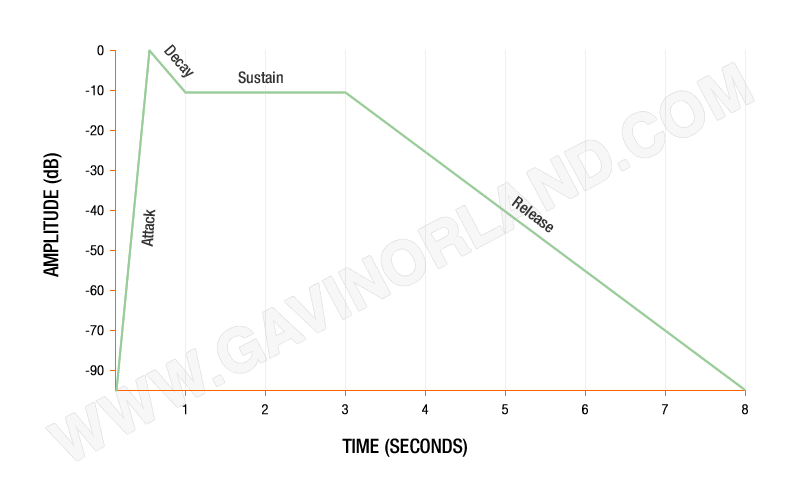
The envelope from http://www.gavinorland.com/tutorials/what-is-an-adsr-envelope/ below


ADSR ENVELOPE

Above, you can see a diagram of an ADSR envelope. I have actually drawn this with realistic proportions. If you imagine a key being pressed on a physical or virtual MIDI keyboard, with a pad patch selected, it might typically produce a sound matching this envelope, and the envelope represents the amplitude (or volume) of the sound generated over time. Let’s have a look at its phases:

Attack phase

The attack phase begins when the MIDI “note on” message is received – when the key is pressed or the note is encountered in a sequencer. You can see in the diagram that this pad begins inaudible then rises in a period of only half a second to the maximum digital volume of 0dB. So this pad starts quite quickly.

Decay phase

The decay phase defines how long the note will take to reach a settled volume after hitting the attack peak. That settled volume is usually lower than the attack peak, since notes in natural instruments tend to “stab” in then fade in intensity a little, but it could indeed be higher. In the example above the pressed note fades again over half a second to a slightly lower amplitude.

Sustain phase

The sustain phase is an important one to understand because the envelope does not determine its duration. Thus the length of the horizontal bar in the diagram (indicating 2 seconds) is actually quite arbitrary. The sustain level is the volume at which the decay will finish and the note will be held at this volume until the MIDI key is released and a “note off” message is received. So this could be after one second or perhaps six seconds.

Release phase

Once the note has been released, the envelope enters its release phase. The line of the envelope here defines how long the note’s volume will take to fade to zero. So in our pad here, it takes a full five seconds, so this is quite a long fade out (with reverb applied it would take even longer!).

Envelope lines do not need to be straight: many synthesisers will allow you to make them curved, making sharper attack sounds, for example. Some even allow additional phases. This, in any case, is the essential outline of the ADSR envelope.